SPYI vs QQQI: Which NEOS Monthly Dividend ETF is Better?
Are you looking to build a reliable monthly passive income stream without sacrificing total return? If so, you’ve likely come across NEOS Investments and their two flagship income generators: SPYI (NEOS S&P 500 High Income ETF) and QQQI (NEOS Nasdaq 100 High Income ETF).
Both funds have taken the dividend investing world by storm by offering 11% to 14% annual yields paid out monthly. But traditional covered call ETFs like QYLD often suffer from “upside capping” and capital erosion. NEOS promises to fix this with their data-driven, tax-efficient option strategy.
But when it comes down to SPYI vs QQQI, which one deserves a spot in your portfolio? Let’s dive into a comprehensive, side-by-side comparison to find the perfect balance between high yield and growth for your financial goals.
What is the Core Difference Between SPYI and QQQI?
At their core, the primary difference between these two ETFs lies in the underlying indexes they replicate and the volatility they capture to generate monthly income.
SPYI: The S&P 500 Defensive Income Engine
SPYI tracks the S&P 500 Index, which represents 500 of the largest, most stable U.S. companies. Because it spans multiple sectors—including finance, healthcare, consumer goods, and technology—SPYI offers a more diversified and defensive approach. It is built for investors who prioritize wealth preservation and steady, lower-volatility income.
QQQI: The Nasdaq 100 Growth Accelerator
QQQI tracks the Nasdaq 100 Index, which is heavily weighted toward mega-cap technology and growth stocks like NVIDIA, Apple, and Microsoft. Because tech stocks naturally carry higher volatility, QQQI can generate higher option premiums, resulting in a juicier dividend yield and higher growth potential during market rallies.
Performance and Yield Comparison: SPYI vs QQQI
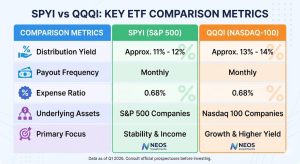
When choosing between these two high-yield options, understanding how they pay you and how they grow is crucial
Why QQQI Offers a Higher Monthly Payout
In the world of covered calls, volatility equals income. Because the Nasdaq 100 moves more aggressively than the S&P 500, the call options that QQQI sells are worth more money. This is why QQQI consistently boasts a distribution yield that is 1% to 2% higher than SPYI.
The Secret Sauce: Out-of-the-Money (OTM) Options
Unlike older covered call ETFs that cap your upside completely, both SPYI and QQQI utilize Out-of-the-Money (OTM) call options. This means if the stock market roars upward, your portfolio doesn’t get left behind. You still capture a portion of the capital appreciation (usually 20-30% of the market’s upside) alongside your massive monthly dividend checks.
Tax Efficiency: The Section 1256 Advantage
For income investors, taxes can eat up a massive chunk of your returns. This is where NEOS ETFs truly shine compared to their competitors.
Both SPYI and QQQI use Section 1256 contracts for their options strategy. Under U.S. tax law, capital gains from these contracts are taxed at a hybrid rate: 60% Long-Term and 40% Short-Term capital gains, regardless of how long the contract was held.
Investor Note: This specific structure allows NEOS to optimize your distributions, often resulting in a significant portion of your income being classified as tax-favorable Return of Capital (ROC) or long-term gains, putting more money back into your pocket.
The Verdict: Should You Buy SPYI or QQQI?
Both of these ETFs are excellent tools for generating retirement income, firing your boss, or building a hands-off digital income stream. The right choice depends entirely on your personal risk tolerance.
Choose SPYI If:
You are approaching or currently in retirement and want to protect your principal capital.
You want a smoother ride with less dramatic daily market swings.
You prefer the broad diversification of the entire U.S. economy (S&P 500).
Choose QQQI If:
You have a longer time horizon and want to capture the massive growth potential of Artificial Intelligence (AI) and tech giants.
Your primary goal is maximizing your monthly cash flow with a 13%+ dividend yield.
You can tolerate higher short-term volatility in exchange for higher total returns over time.
The Ultimate Income Strategy: The Core-Satellite Approach
Many modern passive income investors choose not to pick just one. Instead, they combine them. By allocating 60% to SPYI for a solid, unbreakable foundation and 40% to QQQI for a high-yield growth boost, you can create the ultimate, balanced cash-flowing machine.
Disclaimer: This article is for informational and educational purposes only and should not be construed as professional financial advice. Always conduct your own research before investing.
Leave a Reply